
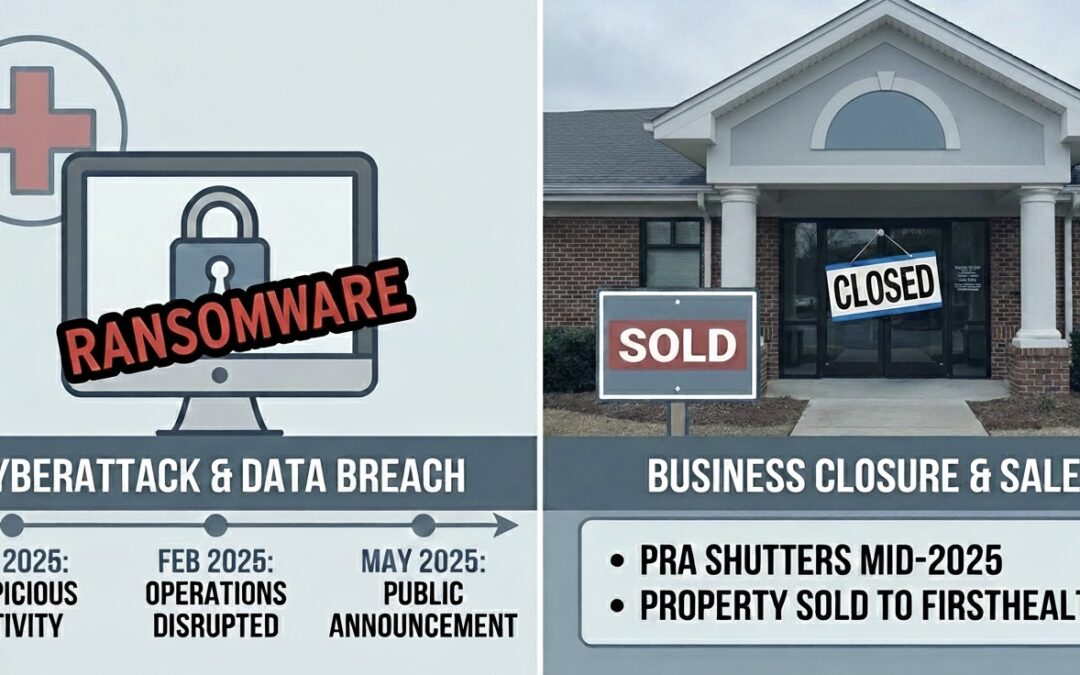
What Pinehurst Radiology Teaches Leaders About the Risk and Reality of Data Privacy.
Some cyber incidents disrupt business. This one ended it.
Pinehurst Radiology Associates had served its community for years: diagnostic imaging, mammography, answers, and peace of mind.
Then a cyberattack hit. Systems failed. Operations stalled. Investigations began. Patients were redirected. Revenue dropped. Costs climbed.
Within months, the practice shut down. This isn’t just a healthcare story. It is a leadership story.
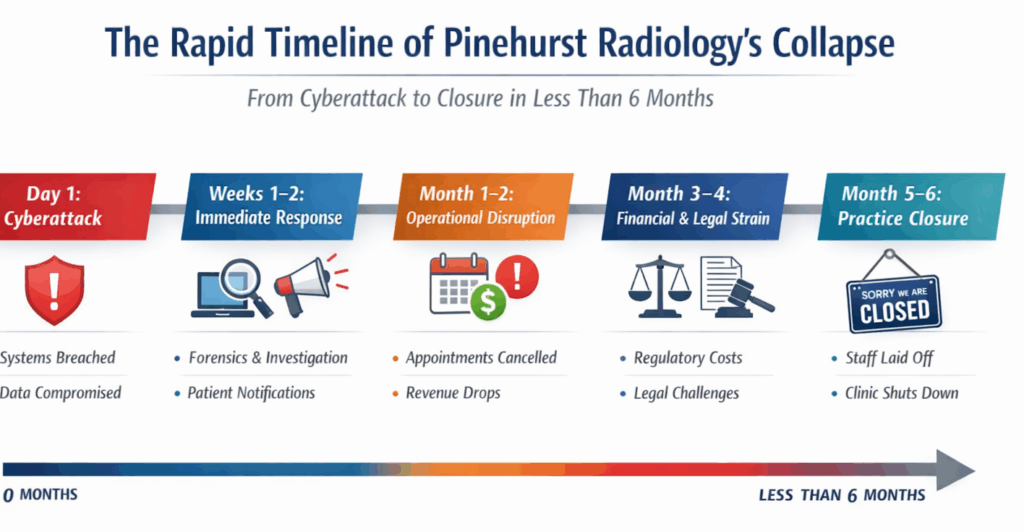
How an incident became a downward spiral
Cyberattacks rarely destroy organizations in one day.
They erode them, financially, operationally, and reputationally.
- Revenue stopped, but expenses did not.
Staff, leases, vendors, legal services, and incident response still needed to be paid. - Regulatory obligations multiplied
Breach investigations, notifications, support lines, and compliance reviews added complexity and cost. - Trust declined fast
In healthcare, confidence is everything. Once shaken, patients move, and many never return. - Modernization lagged behind reality
The environment was “good enough to operate,” but not strong enough to withstand a serious cyber incident.
Over time, disruption became financial stress, and financial stress became existential risk.
This wasn’t just a technical failure. It was a leadership gap.
It is easy to say “they were hacked,” but the deeper issues live above IT.
“We’re too small to be targeted.” Attackers intentionally target smaller organizations because recovery budgets are limited, and pressure is higher.
Security was underinvested before the incident.
Controls, MFA, segmentation, logging, documentation. These are executive decisions, not IT tasks.
No real resilience mindset.
Backups are not resilience.
Resilience means operating, communicating, and recovering without collapsing.
Cyber risk was treated as an IT issue.
Cyber risk is financial, legal, operational, and reputational. Leadership owns it.
Insurance is not a safety net. It is a contract.
Cyber insurance helps. Only when required controls truly exist and are documented.
Insurers increasingly expect:
- MFA everywhere
- logging and monitoring
- privileged-access controls
- clear incident response plans
- governance and documentation
“Partially implemented” often means “not covered.” For smaller organizations, that can be fatal.
Key lessons leaders cannot ignore
- Cyber incidents can close businesses. Permanently.
- Insurance is conditional, not guaranteed.
- Resilience planning belongs in the boardroom.
- Modernizing before an incident costs less than rebuilding after.
- Small organizations still need layered, documented controls.
Final thought
Pinehurst did not close because hackers were sophisticated. It closed because resilience wasn’t designed in.
Cybersecurity today isn’t about stopping everything. It’s about ensuring a cyber incident never becomes a business-ending event.
That requires leadership, not luck.
At Comp4AllWe don’t lead with fear or buzzwords. We help leaders clearly understand:
- What controls actually exist (vs. what’s assumed).
- Where risk truly lives.
- Whether insurance expectations are met.
- What recovery would realistically look like.
Most organizations don’t need “more tools.” They need visibility, alignment, and a plan.
Sources & Notes
This article is based on publicly available information and verified reporting related to the Pinehurst Radiology cyber incident. It draws on breach notices, regulatory disclosures, industry reporting, and independent analyses. The purpose is educational and intended to help leaders better understand the business and governance implications of cyber incidents.
Details may evolve as further updates are released, and timelines, interpretations, and conclusions should not be considered legal or financial advice.